

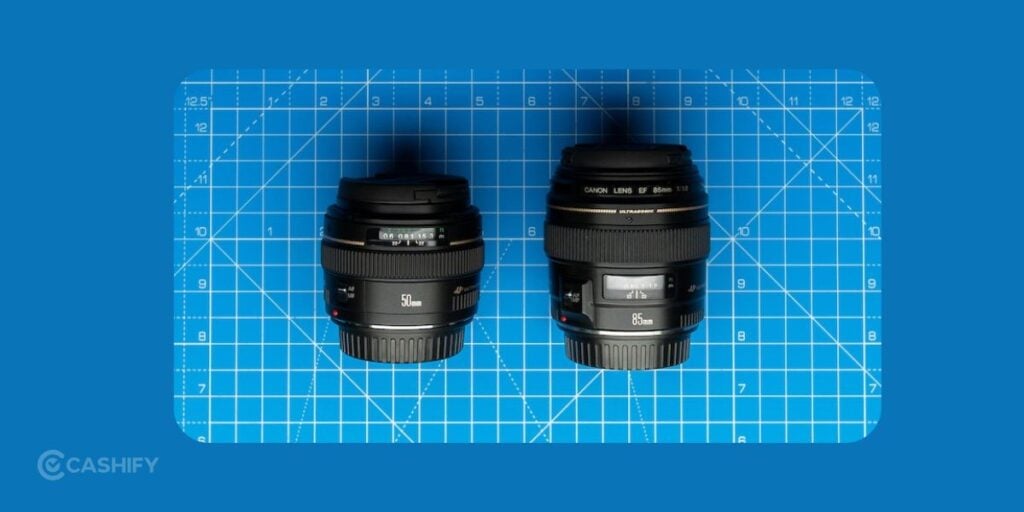
If you are looking for a good portrait lens, it can be confusing to choose between 50mm vs 85mm lens for portrait. Both focal lengths are popular to give you beautiful images.
The real difference comes down to perspective distortion, working distance, and background separation. So, which one should you buy? Let’s check out all the details:
50mm Vs 85mm Lens For Portrait: At A Glance
| Feature | 50mm Lens | 85mm Lens |
|---|---|---|
| Best for | Environmental, lifestyle, full-body portraits | Headshots, close-ups, classic portraits |
| Working distance | Relatively close | Farther away |
| Perspective | Natural, but can look less flattering up close | Flattering for faces |
| Background separation | Moderate to strong | Strong |
| Indoor use | Easier in small spaces | Can feel restrictive |
| Field of view | Wider | Narrower |
| Versatility | Excellent everyday choice | Primarily portrait-focused |
| Crop-sensor use | Similar to a 75mm equivalent | Similar to a 135mm equivalent |
Also Read: Best Cameras For Content Creators: Travel, Vlogging, All Details!
The 50mm Lens: This Is More Natural
A 50mm lens has a field of view that feels relatively natural. It works well when you want your portrait to include some of the surrounding environment. Hence, 50mm is useful for lifestyle portraits, street portraits, travel photography, family sessions, and full-body images.
It is also a good choice for indoors. You do not need to stand very far from your subject. This helps when you are working in a bedroom, small studio, café, or narrow street.
But, if you move very close to someone’s face to fill the frame, the perspective can become less flattering. The nose may appear larger and ears and sides of the face appear smaller. This is often called perspective distortion.
Technically, the lens itself is not simply “distorting” the face. The bigger factor is your camera-to-subject distance. A 50mm usually requires you to move closer for the same framing. This close distance changes how the facial features relate to one another.
The 85mm Lens: This Is For Classic Portraits
An 85mm lens has long been a popular choice for portrait photography. On a full-frame camera, it gives you a narrower field of view. You need to step farther back to frame the same subject.
For a head-and-shoulders portrait, an 85mm lets you capture the face from a comfortable distance. Facial proportions tend to look flattering because you are not standing very close to the subject.
The background isa easier to separate from the subject when you use a wide aperture such as f/1.8 or f/1.4.
But, the 85mm can be awkward in a tiny room. If you need a full-body portrait, you may need to move quite far away. When it comes to outdoors, that is usually easy.
What Is Perspective Distortion?
Perspective is one of the most important things to understand if you are comparing 50mm vs 85mm lens for portrait. Let’s say you are capturing someone’s face from 30 cm away. Their nose is much closer to your camera than their ears. That difference in distance affects how large those features appear.
Now step several feet backward and use a longer focal length to get roughly the same framing. The relative distance between the camera and different parts of the face becomes much smaller. Hence, the features appear more balanced.
This is why an 85mm often gives a flattering portrait. The longer focal length lets you stand farther away while keeping the subject similarly sized in the frame.
A 50mm can still give you excellent portraits. Just avoid getting extremely close for tight headshots.
Also Read: How To Check Used Camera Before Buying? Full Checklist Explained!
Working Distance: How Far Do You Need to Stand?
Working distance is another major difference. A 50mm requires less physical space. You can stand fairly close to your subject and still fit a large portion of their body into the frame.
That makes it useful for:
- Small rooms
- Indoor lifestyle sessions
- Full-body portraits
- Street photography
- Environmental portraits
- Groups and family photos
An 85mm requires more room. For a headshot, this is usually helpful. For a full-body portrait in a small room, it can be frustrating.
What Is Background Separation?

Background separation is one reason photographers often prefer an 85mm for portraits.
A wide-aperture 85mm can give a soft, blurred background. Trees, buildings, lights, and other elements can become soft shapes rather than distracting details. A 50mm can also produce beautiful background blur, particularly at f/1.4 or f/1.8. But its wider field of view tends to include more of the surroundings.
There is an important detail here: focal length alone does not determine background blur. Your aperture, subject distance, camera-to-background distance, sensor size, and framing all play a role.
For the same framing and aperture on the same camera, an 85mm gives you a stronger background separation than a 50mm.
What About APS-C Cameras?
A 50mm lens on an APS-C body gives you a narrower field of view than 50mm does on full frame. This depends on the camera’s crop factor, it has roughly the field of view of a 75mm or 80mm lens on full frame.
That makes a 50mm an excellent portrait option for many APS-C photographers. An 85mm on APS-C is like a 127mm to 136mm full-frame. That can be great for headshots, but it requires even more working distance.
So, if you use APS-C, a 50mm may be the sweet spot for portraits. An 85mm can still be excellent, but you need enough room to use it comfortably.
50mm vs 85mm: The Main Trade-Off
The easiest way to remember the difference is this:
- 50mm gives you more space in the frame and lets you work closer.
- 85mm gives you a tighter view and lets you work farther away.
That change in distance affects the perspective of the face. It also changes how much of the background appears in the frame and how isolated your subject feels.
If you want to buy refurbished DSLR camera lens, Cashify is a good place to find options. You can find refurbished camera lens, second hand DSLR cameras, refurbished gadgets, and refurbished action camera.
FAQs
1. Is a 50mm or 85mm better for portraits?
An 85mm is better for classic portraits and headshots. A 50mm is better for different types of portrait photography.
2. Is 50mm good for headshots?
Yes, a 50mm can work well for headshots. But you need to avoid getting too close to the subject to keep facial proportions natural.
3. Why is 85mm good for portraits?
An 85mm lets you stand farther from your subject, creating flattering facial proportions and stronger background separation.
4. Is 50mm or 85mm better for indoor portraits?
A 50mm is usually better for indoor portraits. It needs less working distance and is easier to use in small spaces.
Final Verdict
For dedicated portrait photography, I would choose the 85mm. The working distance, flattering perspective, and strong background separation make it a natural fit for headshots and classic portraits.
But if you want one lens that can handle portraits, travel, street photography, indoor work, and everyday shooting, choose the 50mm.
If you’ve just bought a new phone and don’t know what to do with your old phone, then here’s your answer. Sell your old mobile to Cashify and get the best price for it. If you are planning to buy a new phone, check out Cashify’s refurbished mobile phones. You can get your favourite phone at almost half price with a six-month warranty, 15-day refund and free delivery.